
A plant can have enough water, enough nutrients and apparently healthy leaves—and still struggle because its roots are too hot.
Root-zone temperature influences root growth, water absorption, nutrient uptake and root-to-shoot signalling. When the root zone becomes excessively warm, roots can lose function before the canopy shows obvious heat damage. That makes soil and substrate temperature one of the most useful—and most overlooked—variables in plant cultivation.
We usually look at the wrong end of the plant
Walk through a greenhouse or crop in summer and most observations begin above ground. Are the leaves wilting? Are stomata closing? Is the greenhouse too hot? Does the crop need more irrigation?
Those are sensible questions. But I would add another: How hot are the roots?
Roots do not experience the same environment as leaves. Their temperature is determined by the soil or substrate around them, solar radiation on containers and beds, moisture, mulch, irrigation water, rooting depth and—in protected cultivation—the physical properties of the growing system.
A leaf can be cooled by transpiration and moving air while a dark container or exposed upper root zone continues absorbing solar energy. The crop therefore has two thermal environments: one above ground and another below it.
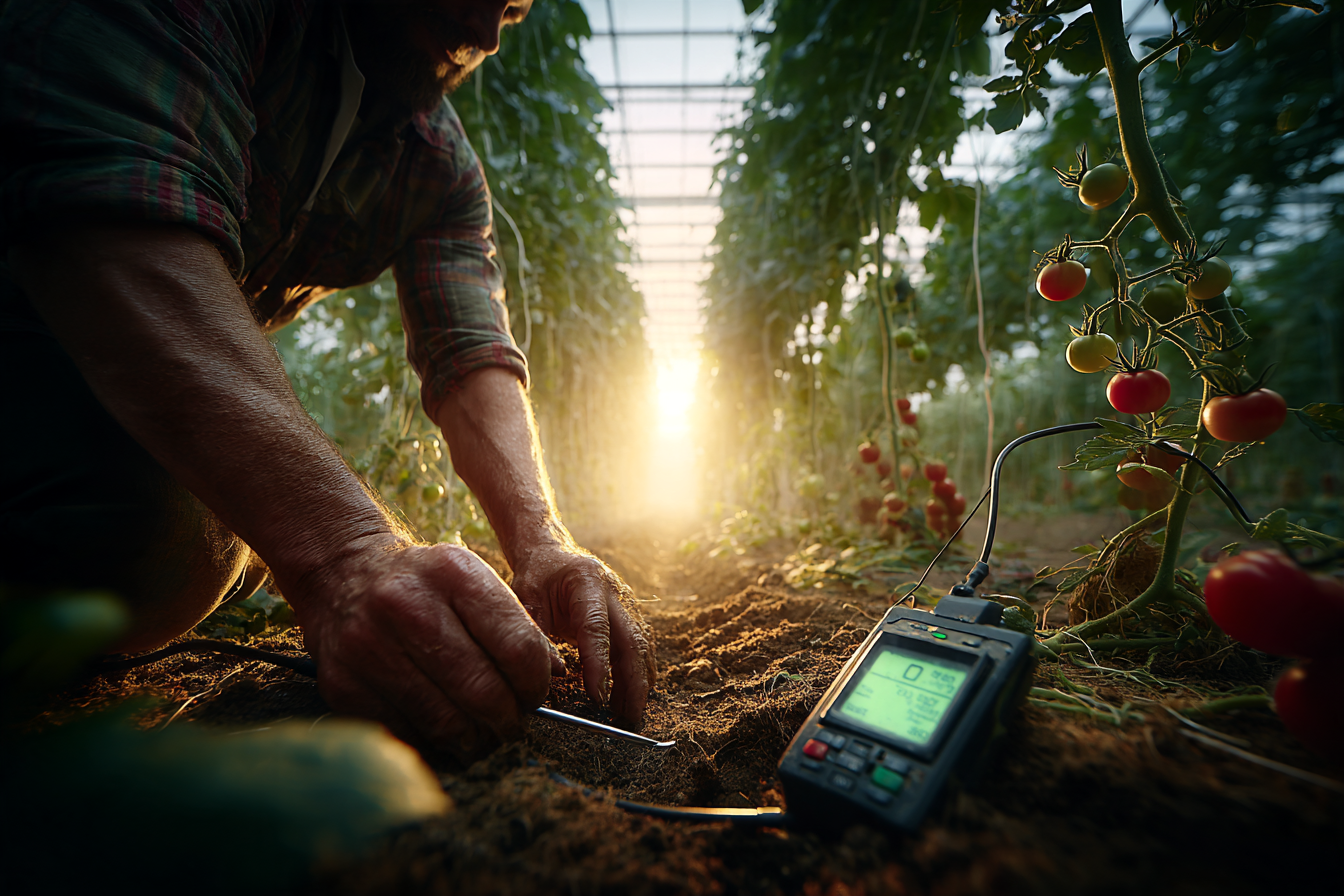
What happens when roots become too warm?
Temperature controls biochemical reaction rates, membrane behaviour, respiration and enzyme activity throughout the plant. Roots are no exception.
As root-zone temperature rises within a species’ useful range, root metabolism may initially increase. But beyond the appropriate range, the balance changes. Respiration costs increase and prolonged or severe heat can impair membranes, root growth and nutrient acquisition.
Experiments with tomato are particularly instructive. Severe heat treatments producing root temperatures around 39°C have reduced root growth more strongly than shoot growth and reduced uptake of several important nutrients. This matters because the root system is not merely plumbing. It is living tissue that must continuously respire, explore the growing medium and maintain transport processes.
Can hot roots look like a watering problem?
Yes—and this is where diagnosis becomes interesting.
A plant showing midday stress may indeed require water. But supplying more water does not automatically solve every apparent water problem. If the root environment is excessively hot, root function itself may be compromised. The plant may therefore have difficulty exploiting the water and nutrients available around it.
That can create a dangerous management loop: plant wilts → grower irrigates more → root zone remains physiologically stressed → grower irrigates again.
In a container or poorly aerated substrate, excessive irrigation can then introduce a second problem: reduced oxygen availability.
The better question is not simply “Is there enough water?” It is: “Can the active root system use the water that is there?”
That distinction connects directly with Why Drip Irrigation Can Still Waste Water. Irrigation efficiency is ultimately determined in the root zone, not at the emitter.
Why does nutrient uptake change?
Mineral nutrients do not simply drift into a plant because fertiliser is present. Roots depend on membranes, transport proteins, respiration and electrochemical gradients to acquire nutrients.
Controlled tomato experiments have shown that severe root heat stress can reduce uptake of nitrogen, phosphorus, potassium and iron. This provides an important practical lesson: a crop displaying a nutrient-related symptom does not necessarily need more fertiliser. The nutrient may already be present. The limiting factor can be the plant’s ability to acquire it.
That is why plant nutrition should never be interpreted separately from roots, water, oxygen, pH, salinity and temperature.
Is there one ideal root-zone temperature?
No. A universal number would be misleading.
Optimal root temperature varies with species, cultivar, developmental stage, growing medium and production system. Warm-season and cool-season plants have different thermal adaptations. Tomato research, for example, reports favourable root-zone conditions across a range depending on the experimental and production system rather than one universal set point.
The useful management principle is therefore not “Keep every root zone at 20°C.” It is: Know the biologically useful temperature range of the crop you are growing, then measure the environment where its active roots actually are.
Where should you measure?
This is one of those details that separates data from useful information.
A thermometer pushed just beneath a sun-baked soil surface tells you about the surface. It may tell you very little about roots 15 or 30 centimetres below. Likewise, measuring the air temperature beside a container does not tell you the temperature inside its root ball.
Measure where the active roots are. In field soil, that may mean taking readings at several depths. In container production, measure inside representative pots—especially those exposed to direct solar radiation. In substrate systems, monitor the actual root-zone environment rather than relying solely on greenhouse-air sensors.
And measure through the day. A single reading at 08:00 can completely miss the afternoon maximum.
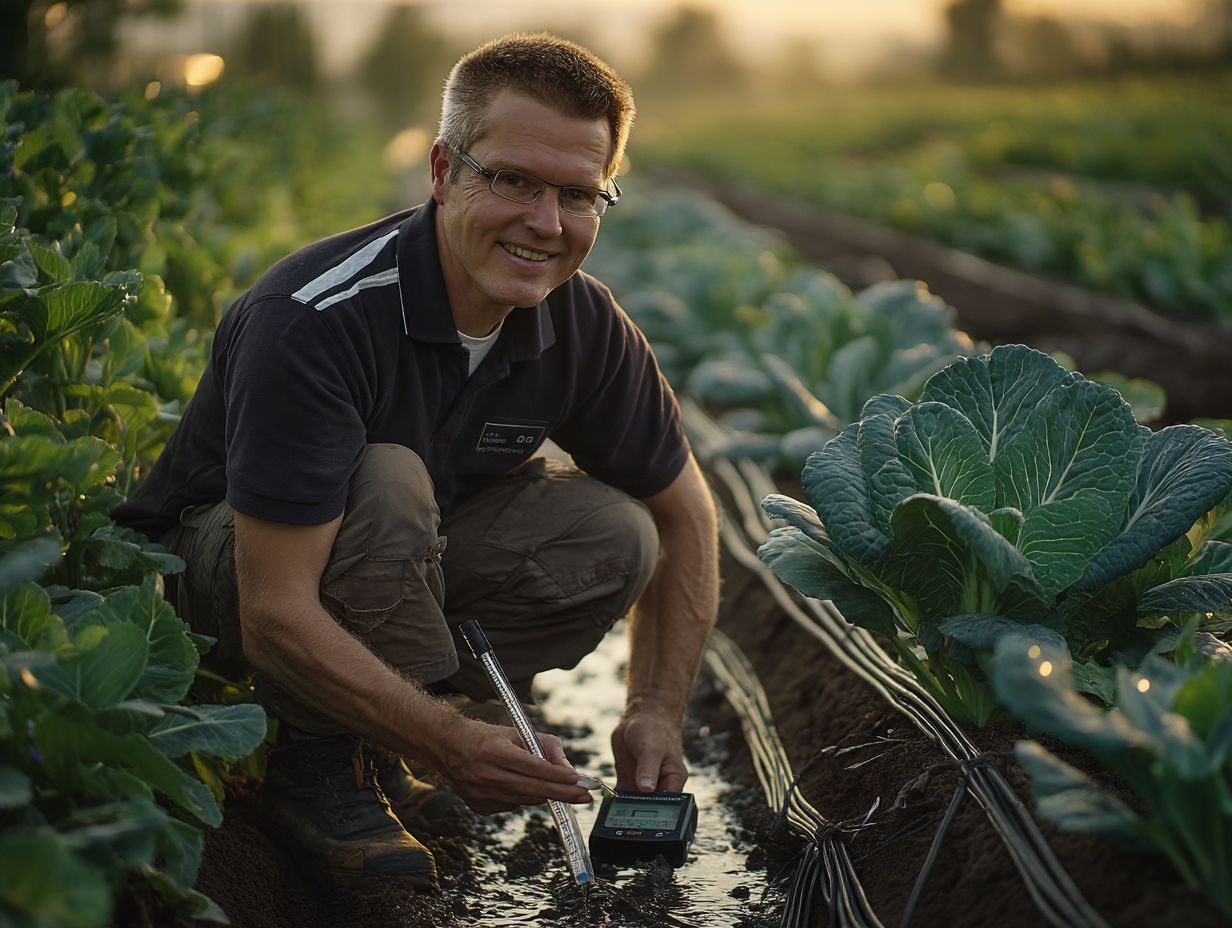
What can growers do about excessive root-zone heat?
The first intervention is observation. Measure before changing the system.
Then consider the mechanisms producing the heat. Shading exposed containers can reduce solar heat gain. Organic or reflective surface covers may alter soil-energy exchange. Maintaining appropriate soil moisture can moderate temperature fluctuations, although irrigation should not be used blindly as a cooling treatment.
In greenhouse and substrate production, container colour, spacing, bench design, substrate volume and irrigation-water temperature can all influence the thermal environment around roots. In field crops, canopy closure itself eventually shades soil—but young crops leave much more soil exposed to solar radiation.
The best solution therefore depends on the production system. There is no single product to buy. There is a system to understand.
The plant is telling us about its environment
This is why I keep returning to roots.
We see leaves because they are visible. Roots require us to investigate. Yet the plant integrates both worlds.
A hot afternoon is not only a leaf-temperature event. Irrigation is not only a water-delivery event. Fertilisation is not only a nutrient-concentration event. Everything meets at the root.
And sometimes the most important heat stress in a crop is the heat we cannot see.
Key takeaways
- Root-zone temperature directly affects root physiology, water relations and nutrient acquisition.
- Excessive root heat can impair root function before dramatic shoot symptoms appear.
- Severe heat can reduce uptake of important nutrients including nitrogen, phosphorus, potassium and iron.
- Apparent irrigation or nutrient problems can therefore have a root-environment component.
- There is no universal ideal root temperature; crop, cultivar and production system matter.
- Temperature should be measured where active roots actually occur and preferably across the daily temperature cycle.
- Diagnose root temperature, moisture, oxygen and nutrition as a connected system rather than treating each separately.
For the wider physiological context, see Plants: Understanding Growth as a Complete System. For irrigation management, continue with Water: Smarter Irrigation and Drought Resilience.
Further reading
For technical background, useful starting points include peer-reviewed research on tomato root responses to heat stress and scientific literature on root-zone temperature, nutrient acquisition and root-to-shoot signalling. When applying published temperature ranges in practice, always account for crop species, cultivar, developmental stage and the production system in which the measurements were made.
Look below the canopy. When a crop behaves unexpectedly during hot weather, measure the environment around the roots before assuming that more water or more fertiliser is the answer.