
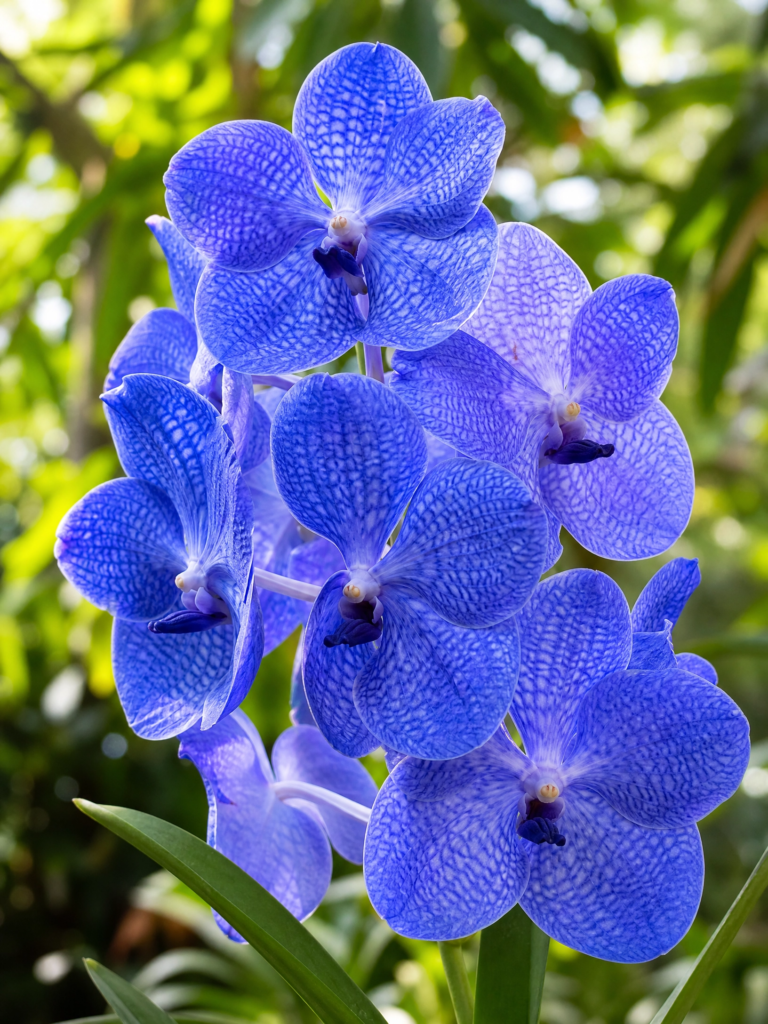
Back in 2000 entrepreneurial grower Stefan van Adrichem (nursery Anco Orchids) experimented growing a novel crop: Vanda orchids. As he was the first trying to grow this crop for commercial flower production in Europe, using a novel crop cultivation system as well, he kindly requested me to do plant research at his plant nursery. I took the challenge by collecting data about plant growth & development, flower production, and performing cultivar trials on site. I also did some tests I felt worthwhile.
At one time he encountered a problem with a particular consignment of plants and consulted me as a sounding board.
The Issue
The problem was confined to a specific batch of plants:
– The plants looked young and healthy, and were synchonously forming a flush of flowers.
– The root system looked OK.
– However, the flowers remained stunted.
My approach
My initial response was that the problem was related to water uptake. And not related to any other knowledge domain. That wasn’t just a guess, but a reasoned approach. For this one needs to have a clear understanding of how an orchid grows. When this group of plants produces flowers, they first form ALL the cells. Subsequently, cell elongation takes place (by water uptake), so flower stalk and flower will rapidly increase in size.
I noticed that, on average, flower petals were more stunted than the flower stalks.
This confirmed my thesis of a water uptake problem. After all, flower parts are further from the roots and therefore will experience a lack of water more severely than the flower stalk.
I asked the grower questions to gradually pinpoint the cause.
What made this particular batch of plants have this issue?
Where did the plants come from?
Within a few minutes I framed a hypothesis that the root system wasn’t functioning properly. To be precise, I framed the imported plants (from Thailand) experienced adaptation problems to the Dutch growing conditions.
I put forward an easy solution: water this batch of plants more often, to compensate for the root deficiency problem.
That solved the problem, within days the flowers developed as normal. Flowers could be harvested and auctioned as normal.
Gradually new roots developed, which were better adapted to cultivation conditions in The Netherlands.
Concluding Thoughts
Finding the cause and solution took me less than 10 minutes.
Had the grower waited 2 more weeks, his flowers would have perished,
and resulted in a financial setback of € >10.000.
Moreover, when not resolved, the same mysterious issue could have occurred again in the future, with additional losses.
Footnotes:
1. Within a few years Mr. Stefan van Adrichem (formerly: Anco Orchids, The Netherlands) and Mr. Tamlong Suphachadiwong (nursery Suphachadiwong Orchids, Thailand) joined forces and founded ANSU Vanda. They became a unicorn: Europe’s sole supplier of Vanda plants and cutflowers.
At the time I already knew Vanda would become the most profitable (and most sustainable) crop I would ever encounter. Some cultivars have magical blue flowers, that can last up to six weeks.
2. During one conversation with Mr. Steef van Adrichem I felt the climate became ‘too stifling‘.
Just as I had remarked my observation, and put a full stop to it,
the greenhouse ventilation windows opened.
My face turned a big smile 😊, as this showed we both were on the very same wavelength.
The fact that the ventilation windows opened, illustrated climatic conditions had reached a tipping point, set by Mr. Steef van Adrichem on his computer, to adjust temperature / humity.
3. Before me, the grower had hired another Plant Expert. As she didn’t meet his expectations, he hired me instead. At the time I had over 10 years of experience growing numerous orchids, as a hobby, both orchid species and hybrids, including Vanda types. I even had a small tissue culture laboratory for propagating orchids from seed.
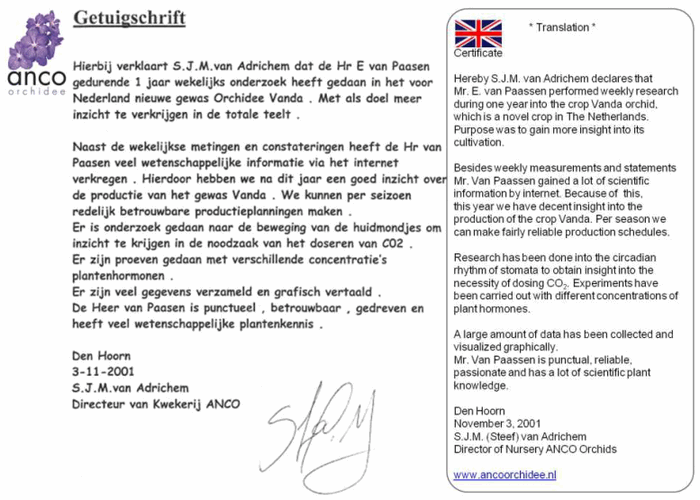
Certificate of Recommendation – Steef van Adrichem
More Case Studies:
 Plant Technical Troubleshooting Peppers
Contact Me !
Do you have an acute plant related problem?  Contact me.