
Source: ipcinfo.org
Introduction
Food security in Sudan has deteriorated into one of the world’s most severe humanitarian emergencies. Defined as the state where individuals have consistent access to enough safe and nutritious food for an active and healthy life, food security remains a distant goal for a large and growing share of Sudan’s population. Since April 2023, the outbreak of a devastating civil war has transformed a chronic food security challenge into an acute, large-scale famine emergency — one that demands urgent international attention.
Timeline: From Chronic Crisis to Active Famine
Understanding Sudan’s food crisis requires distinguishing between its long-standing structural vulnerabilities and the acute collapse triggered by the 2023 civil war:
– **Pre-2023:** Sudan faced persistent food insecurity driven by political instability, poverty, climate variability, and economic mismanagement. An estimated 9.8 million people were severely food insecure.
– **April 15, 2023:** War erupts between the Sudanese Armed Forces (SAF) and the paramilitary Rapid Support Forces (RSF), initially in Khartoum, rapidly spreading to agricultural heartlands.
– **Late 2023:** RSF forces advance into Gezira, Sennar, and Khartoum states — Sudan’s most productive farming regions. Wheat production in the Gezira scheme collapses by 58 percent (FAO, 2024). Cereal production across Darfur and Kordofan falls to 80 percent below average.
– **2024:** Famine (IPC Phase 5) is confirmed in Zamzam displacement camp, North Darfur. The IPC identifies 24.6 million people facing high levels of acute food insecurity.
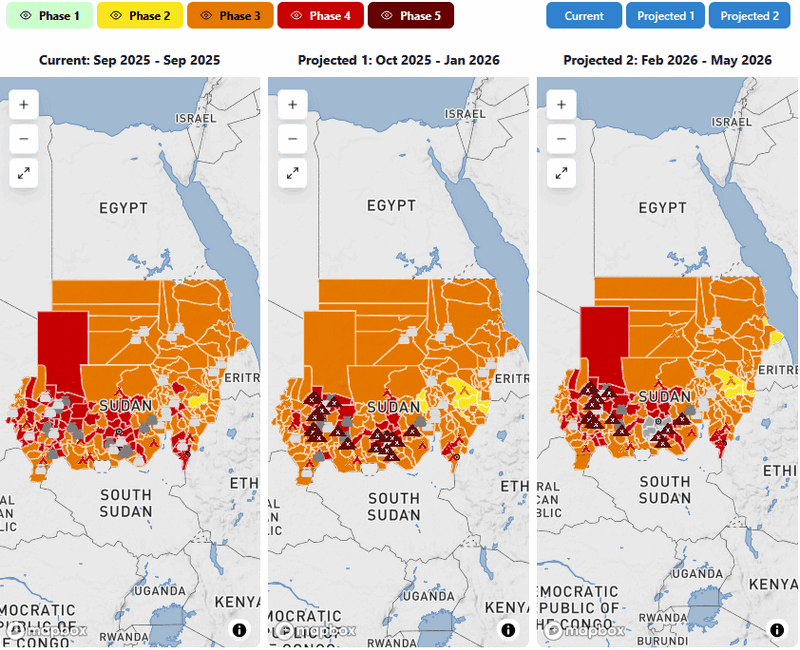
– **September 2025:** Famine is confirmed in El Fasher (North Darfur) and Kadugli (South Kordofan). An estimated 21.2 million people — approximately 45 percent of the population — face crisis-level food insecurity (IPC Phase 3 or above) (IPC, November 2025).
– **2026:** Projections indicate 4.2 million cases of acute malnutrition across the country, including over 800,000 cases of severe acute malnutrition (IPC/UN News, February 2026).
The Civil War as the Primary Driver
The 2023 civil war between the SAF, led by General Abdel Fattah al-Burhan, and the RSF, led by General Mohamed Hamdan Dagalo (“Hemedti”), is the single most important driver of the current food crisis. The conflict originated from a power struggle over the integration of RSF forces into the regular military following the 2021 coup.
Both factions have targeted Sudan’s most fertile regions, disrupting agricultural production, displacing populations, and cutting off communities from their food sources. The RSF in particular has been accused by legal experts and the U.S. government of using starvation as a method of warfare — burning crops, looting warehouses, and attacking farming communities across Darfur’s most productive land.
The agricultural sector, which contributes 35 to 40 percent of Sudan’s GDP and employs over 80 percent of its population (ReliefWeb, 2023), has been devastated. Under a severe downturn scenario, the agri-food sector’s GDP is projected to fall by 26 percent, with employment in the sector declining by 50 percent (Tandfonline, 2025).
By 2025, Sudan had effectively split into two rival military governments: the SAF’s administration in Port Sudan in the east, and the RSF’s administration in Nyala, Darfur in the west — each backed by different foreign powers, with diplomacy largely paralyzed.
Current Food Crisis: Statistics and Impact (2025–2026)
Sudan is now home to the world’s largest humanitarian emergency. According to the most recent IPC analysis (November 2025):
– **21.2 million people** — approximately 45 percent of the analyzed population — faced crisis-level food insecurity (IPC Phase 3 or above) as of September 2025 (IPC, 2025).
– **Famine (IPC Phase 5)** has been confirmed in El Fasher, North Darfur and Kadugli, South Kordofan, with at least 20 additional localities at risk if conflict intensifies or humanitarian access remains blocked (IPC, 2025).
– **4.2 million cases of acute malnutrition** are projected for 2026, including over 800,000 cases of severe acute malnutrition — a sharp increase from 2025 levels (UN News, February 2026).
– In Um Baru, North Darfur, acute malnutrition among children reached **52.9 percent** — nearly twice the famine threshold (IPC alert, February 2026).
– **Over 30 million people** require humanitarian aid, representing approximately 10 percent of global humanitarian needs (IRC, 2026).
– More than **150,000 people** have been killed since the conflict began (IRC, 2026).
The humanitarian impact extends beyond hunger. Households are forced into negative coping strategies — reducing meal sizes, withdrawing children from school, and resorting to child labour. Food prices have risen dramatically, driven by market collapse, currency devaluation, and disrupted supply chains. Women and female-headed households are disproportionately affected: before the crisis, 42 percent of female-headed households already had less food than male-headed households (CARE/ReliefWeb, 2023).
Root Causes of Food Insecurity
 Political Instability and Armed Conflict
Sudan has experienced prolonged governance crises, regime changes, and armed conflict since independence. The 2023 civil war is the most severe in recent history, displacing millions, destroying infrastructure, and preventing farmers from accessing their land during critical planting seasons.
Economic Collapse
Hyperinflation, currency devaluation, and the destruction of productive capacity have made basic commodities unaffordable for the majority of citizens. The agricultural sector faces a near-total collapse in conflict-affected regions, undermining both food production and rural livelihoods.
Structural Agricultural Vulnerabilities
Even before the war, Sudan’s agriculture was heavily dependent on rain-fed farming, leaving it exposed to climate variability. Limited investment in modern techniques, outdated infrastructure, and poor market access compounded these vulnerabilities.
Social Inequality
High levels of poverty, limited access to education and resources, and gender inequality perpetuate cycles of food deprivation. Women, in particular, bear a disproportionate burden of food insecurity due to restricted access to land, credit, and markets.
Climate Change and Its Effects on Agriculture
Climate change has significantly amplified Sudan’s pre-existing agricultural vulnerabilities. Rising temperatures, increasingly erratic rainfall, and more frequent extreme weather events — both droughts and floods — disrupt planting and harvesting cycles and degrade soil health.
Droughts are becoming more frequent and intense, threatening rain-fed agriculture on which the majority of Sudan’s smallholder farmers depend. Conversely, heavy flooding washes away seeds, destroys crops, and erodes fertile land. These climate pressures compound the effects of conflict, making agricultural recovery even more difficult in already-affected regions.
Adaptive responses — including sustainable farming practices, investment in irrigation, drought-resistant crop varieties, and soil health management — are urgently needed. However, the ongoing conflict severely limits the capacity to implement such measures at scale.
A Fragile and Uneven Picture: Where Conditions Have Improved
It is important to note that the crisis is not uniformly worsening across all of Sudan. Since May 2025, a gradual stabilisation in Khartoum, Al Jazirah and Sennar states — following SAF recapture — has allowed some families to return home, markets to reopen, and humanitarian access to partially recover. As a result, an estimated 3.4 million people are no longer facing crisis-level hunger compared to the December 2024–May 2025 period (FAO/WFP/UNICEF, November 2025).
However, these gains are fragile and highly localised. Many returning families have lost everything and cannot fully benefit from harvests. In North Darfur and Greater Kordofan, where conflict remains intense, conditions continue to deteriorate.
Future Outlook (2026 and Beyond)
The outlook for food security in Sudan depends overwhelmingly on one factor: whether the conflict ends or continues.
Under the most likely scenario — with fighting persisting in Darfur and Kordofan — IPC projects that approximately **19.1 million people** will continue to face crisis-level food insecurity through mid-2026, with hunger expected to worsen from February 2026 as food stocks run out (IPC, 2025). Famine risk remains high in at least 20 additional localities across Greater Darfur and Greater Kordofan.
Even with a ceasefire, recovery will be slow. The Gezira irrigation scheme — historically producing half of Sudan’s wheat — remains severely damaged. Agricultural employment has collapsed, infrastructure has been destroyed, and public services including health and nutrition systems have disintegrated in many areas.
Long-term sustainable food security will require not only an end to hostilities, but investment in infrastructure, agricultural reform, climate adaptation, and inclusive economic recovery.
Improving Food Supply Chains
Addressing supply chain failures is essential to both immediate relief and long-term recovery: Agricultural productivity:
introducing modern farming techniques, drought-resistant varieties, and training programs for farmers through NGO and expert partnerships. Transportation infrastructure:
investing in road networks, logistics systems, and cold storage facilities to reduce transit times and post-harvest losses. Reducing food waste:
educating consumers on food storage, redirecting surplus produce to food banks, and deploying tracking technologies across the supply chain. Restoring market access:
reopening commercial supply routes and stabilising food prices, which are critical to both urban and rural food access.
Domestic Prerequisites for Improvement
Effective and lasting improvement requires several foundational domestic conditions: Ceasefire and political stability: without an end to hostilities, all other interventions remain insufficient. Investment in agricultural infrastructure: irrigation systems, rural roads, storage facilities, and market access. Policy reform: subsidies for local farmers, clear land ownership laws, and enabling environments for agricultural investment. Farmer support: education and training in sustainable practices, crop rotation, pest management, and cooperative structures to improve bargaining power.
International Cooperation and Support
International cooperation is indispensable. The United States, the United Kingdom, and European nations, channelling aid through the WFP, FAO, and UNICEF, are working to implement food relief programs, scale up nutritional support, and advocate for humanitarian access.
The IPC, FAO, WFP, and UNICEF have repeatedly called for: (1) an immediate ceasefire; (2) unimpeded humanitarian access, particularly to El Fasher, Kadugli, Dilling, and Greater Kordofan; and (3) large-scale data collection to monitor conditions in inaccessible areas.
Local-international partnerships that train farmers and build community resilience remain critical — but they cannot substitute for political solutions that restore safety and access.
Conclusion
Sudan’s food crisis has moved far beyond a chronic development challenge. Since April 2023, the civil war has transformed pre-existing vulnerabilities into an active famine emergency of historic proportions. With 21.2 million people facing crisis-level food insecurity, famine confirmed in multiple locations, and projections worsening into 2026, the international community faces an urgent moral and humanitarian imperative.
Sustainable food security in Sudan requires a ceasefire first, followed by coordinated efforts across agricultural recovery, infrastructure investment, economic reform, climate adaptation, and inclusive governance. Without peace, no other intervention can be fully effective.
References
Al Jazeera (May 4, 2026). Satellite imagery reveals how Sudan’s war scorched its breadbasket.
FAO, WFP & UNICEF (November 4, 2025). Famine conditions confirmed in Sudan’s El Fasher and Kadugli.
IFPRI (November 13, 2025). IPC: Famine and food insecurity spread in Sudan as humanitarian crisis worsens.
IPC (2025). Sudan: Acute Food Insecurity Situation for September 2025 and Projections for October 2025 – January 2026 and for February –
May 2026.
IRC (2026). Crisis in Sudan: What is happening and how to help.
ReliefWeb/OCHA (May 28, 2023). Sudan: Clashes between SAF and RSF — Flash Update No. 14.
UN News (February 5, 2026). Child malnutrition hits catastrophic levels in parts of Sudan.
Wikipedia (2024–present). Famine in Sudan.