Can a simple ditch bring a desert back to life? Yes, it can. Dutch inventor Peter Westerveld proved it in Africa. His method is called contour trenching. You dig trenches in dry land, and they catch the rain. As a result, plants return — even in places with less than 100 mm of rain per year. The idea is cheap, simple and easy to scale. Today, the organisation Justdiggit carries his work forward. So far, it has dug over 800,000 water basins in Africa. This method improves peoples lives and can combat Climate Change.
Hopefully, Australia and the Middle East will also embrace this concept.
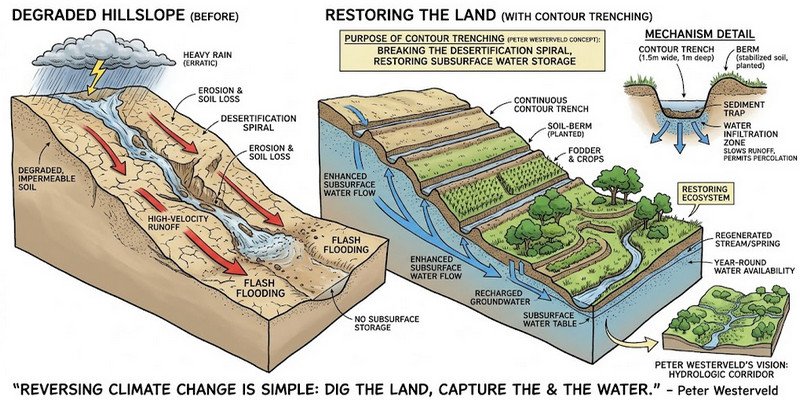
The problem: rain that runs away
Dry regions have a strange problem with rain. The bare soil bakes in the sun and forms a hard crust. Because of that crust, rain can hardly sink into the ground. Instead, the water races off over the surface. Within minutes, small streams grow into wild rivers. So a region loses its precious rain in a flash. Even worse, the water drags the fertile top layer of soil with it. What stays behind is bare, poor land where little can grow.
The solution: dig trenches
The fix sounds almost too simple. You dig trenches along the contour lines of the land. Contour lines connect points of equal height. Therefore, a trench on a contour line lies level, and water stays in it. The trenches only need to be 30 cm to 1 meter deep.
The effect is threefold:  First, the trenches stop erosion. The trenches catch the rain and stop the runoff. The fertile top layer, which holds most of the food for plants, stays in place. Second, the ground water level rises. Water in the trenches has time to sink into the soil slowly. Third, the moist trenches create a milder microclimate. Seeds sprout, grass returns and shade follows. Step by step, a sturdy ecosystem can grow. Later, the land can even support growing crops: annuals, bulbs, shrubs and trees.
Three patterns for three landscapes
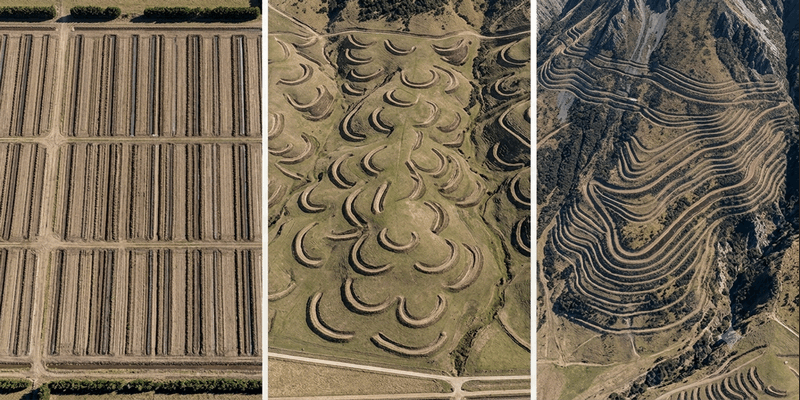
Left: Flat land with straight trenches.
Middle: Hilly land with C-shaped basins.
Right: Mountain slopes with long, contiuous trenches. Each trench runs at a constant elevation along the slope.
The shape of the trenches depends on the terrain. On flat land, you dig straight trenches of limited length, laid out in rows. On hilly land, C-shaped basins of about 4 metres work best. Their open side faces uphill, so they catch the water that flows down. On mountain slopes, long continuous trenches are cut across the slope. In all three cases, the principle stays the same: stop the water runoff, and let it sink in.
The man with the digger
Peter Westerveld (1951–2014) was an artist and inventor who grew up partly in Africa. For years, he dug trenches in Kenya, Tanzania and Mali, and watched bare land turn green. His dream was huge. He designed a “Hydrologic Corridor” for Kenya: one connected water system of 20,000 km². In 2008, he founded the Naga Foundation together with social entrepreneur Dennis Karpes. A film about his life, The man who wanted to change the world, (original title in Dutch: De man die de wereld wilde veranderen), came out after his death in 2014.
The results are impressive. So far, Justdiggit reports over 800,000 water bunds dug, 525,000 hectares under restoration and 32.3 million trees recovered. And the mission goes on: the group wants to regreen large parts of Africa by 2030, together with millions of farmers.
Watch contour trenching in action
Continuous contour trenches in practice in India (YouTube)
Planting trees, pushing back the desert in Israel (YouTube)
The Great Green Wall of Africa: How the UN pushes back the Sahara
Related Articles on this Site
Contour Trenching: Just Dig, and the Desert Turns Green The Water Pyramid: Producing Drinking Water in the Desert The Waterboxx: Enabling Tree Growing in the Desert
Sources and Further Reading
Justdiggit — official website, with current project results Ask the Right Question — Justdiggit and Peter Westerveld’s Hydrologic CorridorHandWiki Countour Trenching