Lack of water threatens drinking water and food crops in many warm regions. However, Dutch engineer Martijn Nitzsche found a clever answer: the Water Pyramid. This large solar still turns salt or dirty water into clean drinking water. Moreover, it needs nothing but sunlight. Twenty years on, the pyramid has a strong track record. Meanwhile, the company behind it has taken a new path.
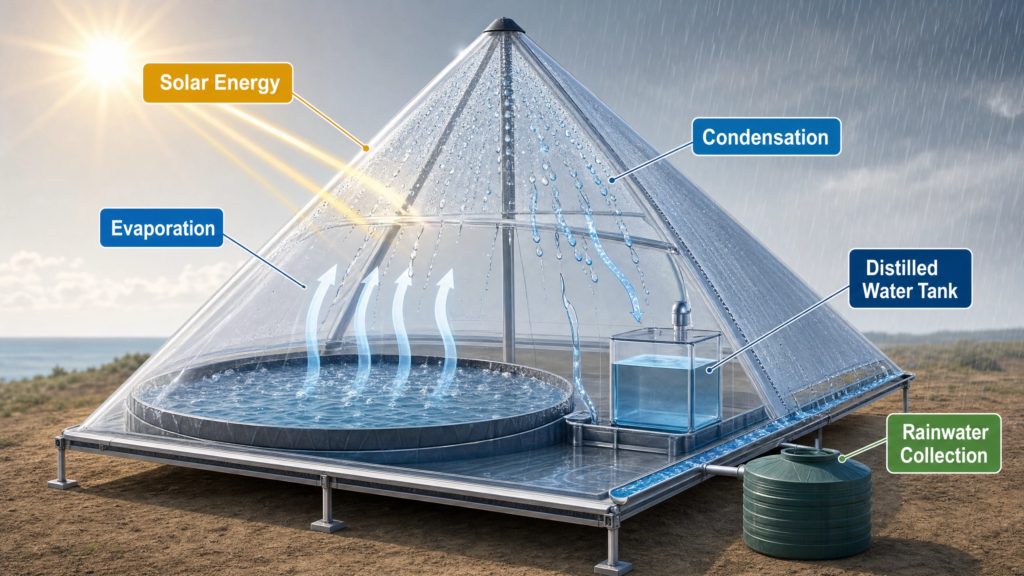
How the WaterPyramid produces two streams of drinking water: distilled water inside, harvested rainwater outside.
What is the Water Pyramid?
The Water Pyramid is a large balloon of clear foil, shaped like a pyramid. A solar-powered fan keeps it firm with light air pressure. The pyramid stands about 8 metres tall. Its base can be up to 30 metres wide. Because the foil is clear, sunlight can pass through it. Inside, the light heats a shallow layer of water.
How it works
The pyramid collects pure water in two ways:
 Inside: solar distillation. First, a small pump feeds salt or dirty water into a basin inside the pyramid. The sun then heats the water to 50–70 °C. So the water turns into vapour. Next, the vapour cools against the inner wall. There it becomes pure water again, which runs down the foil. Finally, gutters catch this water and lead it to a storage tank.
Outside: rainwater harvesting. The outer surface of the pyramid also works as a rain catcher. Rain runs down the foil into gutters at the base. A second tank then stores this water. The yield depends on local rainfall. In tropical Africa, for example, it can add several hundred cubic metres per year.
oth types of water are safe to drink. In warm regions, one pyramid of around 600 m² makes up to 1,000–1,250 litres of pure water per day. Does a village need more? Then it simply adds one more pyramid.
The concept rests on simple laws of nature: heat, vapour and gravity. Therefore, it needs no chemicals and almost no power. As a result, it works well in remote places with no power grid.
Because the concept relies on natural principles — evaporation, condensation and gravity — it needs no chemicals, no membranes and hardly any external energy, making it well suited to remote, off-grid communities.
More than technology: watershops and local enterprise
From the start, Nitzsche saw the Water Pyramid as a business, not just a machine. The local community runs it, which creates jobs. People also sell the extra pure water, for example to fill batteries. Furthermore, local watershops sell the drinking water. Small loans often help to start these shops. So the system pays for itself and does not lean on donors.
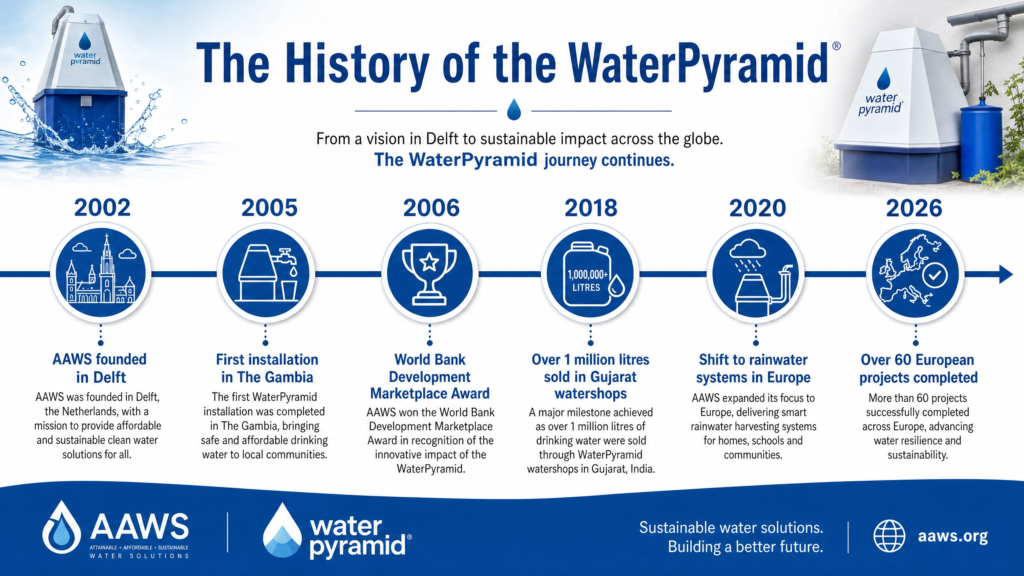
*Two decades of the WaterPyramid, from The Gambia to a new focus on Europe.*
From The Gambia to the world
Nitzsche started Aqua-Aero WaterSystems (AAWS) in Delft in 2002. Three years later, his team built the first WaterPyramid in The Gambia, with the engineering firm MWH Global. Soon after, the concept beat some 2,500 rivals. As a result, it won the World Bank Development Marketplace Award 2006.
After that, AAWS took its pyramids and watershops to four continents. For instance, watershops opened in Gujarat (India), on Bali and in Sierra Leone. Indeed, the Gujarat shops had sold over a million litres of drinking water by 2018. Projects also followed in Kenya, Senegal, Tanzania, Mozambique, Nepal and a refugee camp in Greece. Along the way, the company added new products. For example, a UV water box and a simple way to remove fluoride and arsenic fro
Where the Water Pyramid stands today
Around 2020, the story took a new turn. Climate change has made water scarce in Europe too. Think of dry summers and falling groundwater levels. AAWS therefore moved its focus to the Dutch and European markets From Delft, the company now builds rainwater systems for homes, firms and public buildings. So far, it has finished over 60 projects. They range from hospitals to fire stations that fight fires with clean rainwater.
Still, the core idea stays the same. Catch the water that nature gives. Then clean it with simple, sturdy tools. And above all, stop wasting drinking water on tasks that don’t need it. The pyramid once brought drinking water to villages in The Gambia. In a sense, it has come home. Its lessons now help Europe cope with a drier climate.
Watch the Water Pyramid in action
Martijn Nitzsche explains the Water Pyramid (YouTube)
More videos from Aqua-Aero WaterSystems *(in Dutch)*
Related articles on this site
The Intersection of Agriculture, Sustainability, and Innovation
Exploring Modern Agriculture: Sustainability and Expertise in Plant Sciences
Sources and further reading
Aqua-Aero WaterSystems (AAWS) — official company website
Out of Africa — TU Delft Delta — interview on the move to Asia