We spend about 90% of our lives indoors. Meanwhile, climate change pushes us inside even more, into cooled offices and heated homes. So the question matters: what do plants do for us in there? The honest answer has two parts. First, plants do not clean your indoor air — that is a myth. However, they do something at least as valuable: they clearly improve how we feel, focus and work.
First, the myth: plants as air purifiers
The story began in 1989, when NASA tested plants in small, sealed lab chambers. The plants removed some harmful substances there, and a legend was born. However, your living room is not a sealed chamber. Real buildings exchange air all the time. In 2019, researchers at Drexel University reviewed a dozen studies and settled the question. You would need 10 to 1,000 plants per square metre to rival a couple of open windows. In short: buy plants because you love them, not as air filters.
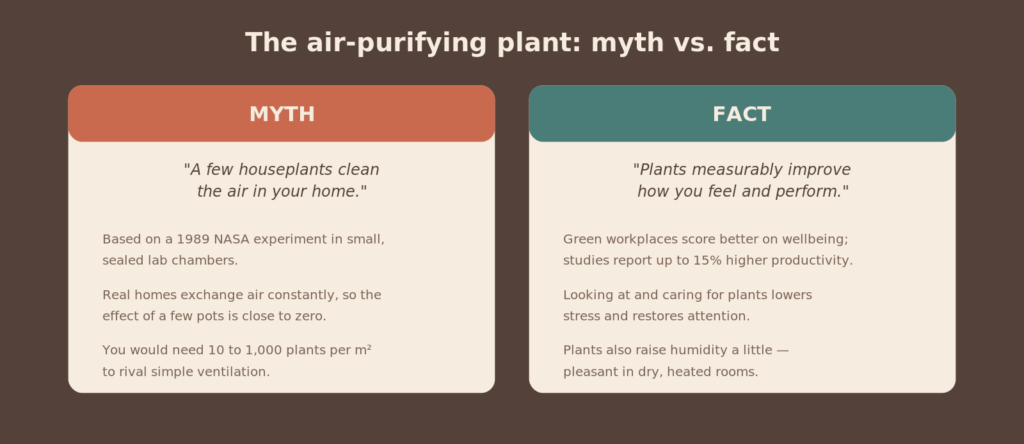
The 1989 NASA myth, retired — and the real benefits that replace it.
Now the facts: what plants really do
The good news is much bigger than the myth. Decades of research show that greenery indoors changes how people feel and perform.
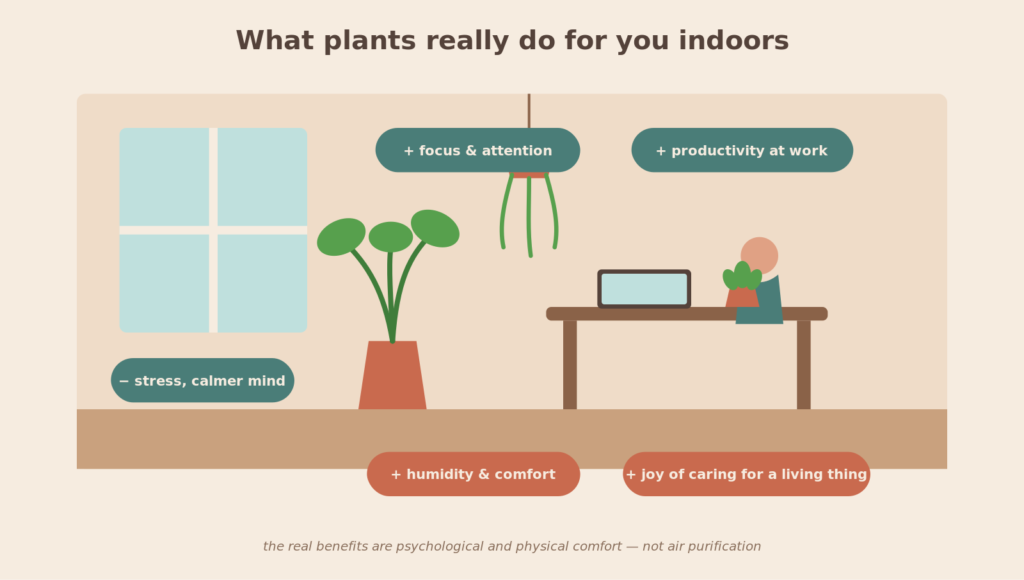
Less stress. Looking at plants calms the nervous system. Even a short break with greenery lowers tension. Caring for plants works even better: watering and pruning are small, mindful rituals.
More focus. Our attention recovers faster with nature in view. Therefore, a plant near your desk is not a distraction. It is maintenance for your concentration.
Better work. Green offices beat bare ones. For example, University of Exeter researchers found that office plants can lift output by around 15%. As a result, “lean” plant-free offices are quietly fading out.
More comfort. Plants release moisture. Consequently, they soften the dry air of heated and air-conditioned rooms. Your eyes, skin and throat notice the difference.
The science behind the calm
This is not just a nice feeling; it is a measurable body response. Greenery calms the nervous system, and the effect shows up in the numbers. As a result, plants lower our stress hormone (cortisol), slow the heart rate, ease blood pressure and relax the muscles. We even breathe more easily. Importantly, this holds most strongly in confined settings — exactly the offices, homes and hospital rooms where we spend our days.
Two landmark studies explain why. First, back in 1984, Robert Ulrich showed that hospital patients with a view of trees recovered faster than those facing a brick wall. From this grew his Stress Reduction Theory: because humans evolved in nature, the brain reads greenery as safe, and the body relaxes on its own. Cities, by contrast, tend to keep our stress switched on. Second, and much more recently, Zandi and Wung (2025) reviewed 124 studies of plants in confined spaces. Their conclusion is clear: greenery lowers stress, lifts mood and speeds recovery. In short, the evidence has only grown stronger with time.
Green design for a warming world
These effects now shape how offices, schools and hospitals are designed. The approach is called biophilic design: building with our inborn love for living things in mind. Think of plant walls in offices, green atriums in hospitals and courtyard gardens in schools. Outside the window, the same logic continues. Urban trees cool the neighbourhood, and green roofs cool the building. Indoors, plants then complete the chain — from the city, through the building, to your desk. Together, they form one holistic green system.
Choosing plants that thrive
A struggling plant helps nobody’s mood. So choose for your conditions, not for the catalogue photo. In dark rooms, choose shade-tolerant species such as Zamioculcas, Sansevieria or ferns. In bright rooms, almost anything thrives — from Monstera to citrus. Forgetful waterer? Then succulents and Zamioculcas forgive you. Above all, start small and let the collection grow with your confidence. For advice on plant choice for homes, offices or public buildings, feel free to get in touch — plant knowledge is the heart of my services.
Related articles on this site
 Climate Change and Sustainability: The Role of Trees in Urban Landscaping
Climate Change and Sustainability: The Role of Green Roofs in Urban Landscaping
A Holistic View on Agriculture, Communities, Sustainability and Innovation
Sources and further reading
Ulrich, R.S. (1984). View Through a Window May Influence Recovery from Surgery. *Science* 224(4647), 420–421. — the foundational Stress Reduction Theory study.
Zandi, A., & Wung, S.F. (2025). Health effects of plants, light, and natural elements of biophilic interventions in confined settings: a systematic review. *Frontiers in Physiology* 16, 1700518. — a review of 124 studies confirming reduced stress, better mood and faster recovery.
Drexel University — Potted plants do not improve indoor air quality
ScienceAlert — Review confirms houseplants aren’t purifying your air
ScienceDaily — Study: potted plants don’t improve indoor air quality