
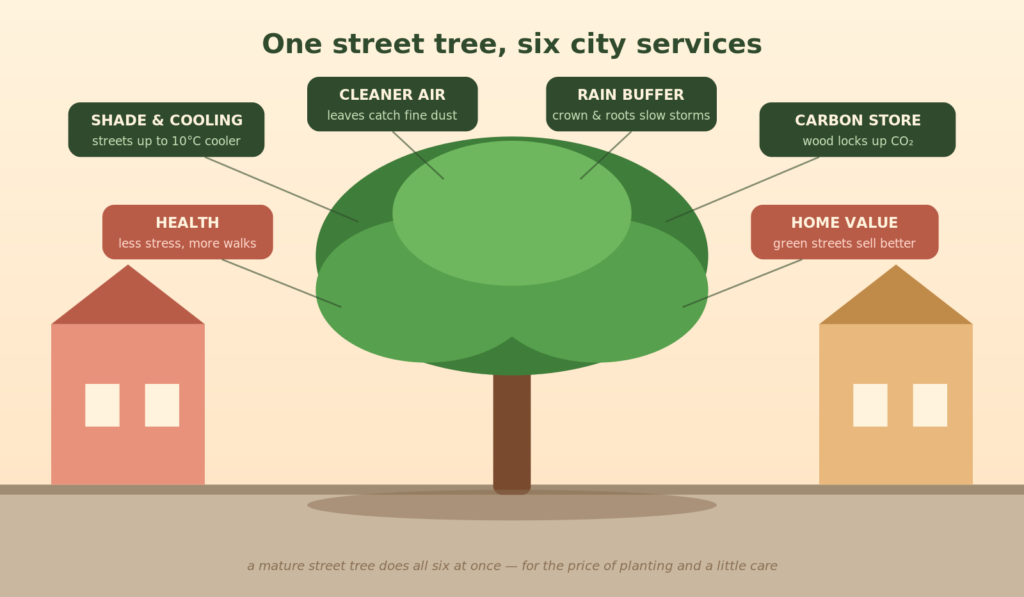
No machine cools a street like a tree does. Meanwhile, our cities keep getting hotter, wetter and more polluted. In an era of climate change, that matters more each year. So planners everywhere are rediscovering the oldest piece of climate technology we have. In a city, large trees especially do a lot of good — for people, insects and the wider ecosystem. This article walks through what urban trees do, and how the simple 3-30-300 rule can guide every neighbourhood.
Benefits of Urban Trees
Shade: direct cooling
The most obvious gift of a tree is shade. Leaves block the sun, so the ground below stays cooler. Naturally, the more leaves a tree has, the bigger the effect. Dark green leaves also soak up more sunlight, while patchy leaves cope less well with stress. Red leaves are even more curious: they may have evolved to suit hot cities 1.
In my view, we often underrate what shade does for people. Hot nights spoil our sleep. Moreover, long heat waves take a real toll on the mind. A shaded street is therefore not a luxury. It is public health.
Evaporation: the natural air conditioner
Trees cool in a second, quieter way. A large tree works like a natural air conditioner. It draws up water and lets it out through its leaves, and that moisture cools the air. The contrast with hard surfaces is stark. Asphalt, brick and stone turn sunlight into heat and store it all day. Then, at night, they let that heat out slowly, so the city stays too warm. Plants do the opposite: they use the sun’s energy to grow and to breathe out water. Once again, the more leaves, the stronger the cooling.
Rainwater management
Climate change brings more extreme weather. As a result, cities face higher risks from flooding, storms and hail. Here trees help as well. Roots and soil soak up rainwater, which reduces surface runoff. Consequently, the flood risk drops and the pressure on the sewer system eases. This is the same idea as contour trenching in dry regions: hold the water where it falls.
Biodiversity
A tree is also a home. Birds, insects and other city wildlife shelter and feed in its canopy. In dense neighbourhoods, that role grows ever more important for restoring urban ecosystems. Indeed, trees do for the city what hedges do for farmland: they connect habitats into a living network.
Phytoremediation: plants against pollution
Pollution is a growing worry, both in the air and in the soil. Air pollutants include carbon dioxide, carbon monoxide, nitrogen dioxide, sulphur dioxide, ozone, VOCs and heavy metals. Soil pollutants include nitrates, phosphates, heavy metals, pesticides, microplastics, drug residues, PFAS and germs. Remarkably, plants can tackle many of these in several natural ways. Together these ways are called phytoremediation:
 Phytodegradation — the plant breaks pollutants down into harmless compounds.
Phytostimulation — soil bacteria around the roots break pollutants down.
Phytostabilisation — the plant holds pollutants in its roots or binds them to soil particles.
Phytosequestration — the plant draws pollutants up and stores them in above-ground biomass. (When that biomass is then harvested to remove the pollutants, we call it phytoextraction.)
Phytotransformation — the plant converts toxic substances into less harmful forms.
Phytovolatilisation** — the plant releases pollutants from the soil into the air.
The fight against pollution will, in time, give rise to whole new fields of expertise within plant sciences.
More benefits of Urban Trees, from noise to food
Trees keep giving in ways that are easy to miss. Noise reduction: leaves and branches absorb and deflect sound, so greenery softens traffic and city noise. Wind control: tall buildings can channel and speed up wind, creating gusty corners — the wind-tunnel effect — but well-placed trees calm that turbulence. Urban food: fruit trees and edible planting increasingly serve community wellbeing and food security. Economic value: finally, homes in a green neighbourhood are simply worth more.
Carbon sequestration
There is also the long game. As trees grow, they absorb CO₂ and lock the carbon away in their wood. So every mature tree is a small, living carbon store — modest on its own, but meaningful across a whole city, and directly relevant to climate change mitigation.
The 3-30-300 rule
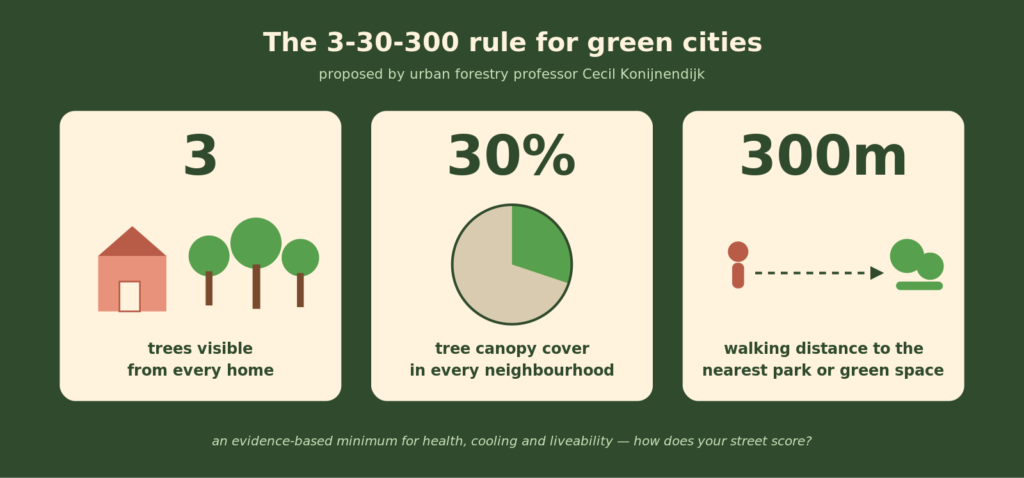
How much green does a neighbourhood need? Urban forestry professor Cecil Konijnendijk gave a memorable answer: the 3-30-300 rule. Everyone should see at least 3 trees from their home. Every neighbourhood should have at least 30% tree canopy cover. And everyone should live within 300 metres of a park or green space. The rule is simple on purpose. As a result, residents, councils and developers can all check it for their own street. Moreover, the IUCN Urban Alliance now promotes it as a global benchmark for healthy cities.
The right tree in the right place
Planting is the easy part. However, a city is a hard place for a tree: little soil, much pavement, heat, drought and road salt. Therefore, three principles matter. First, give roots room; a street tree needs generous soil volume, or it will never reach maturity. Second, match the species to the site. Think of drought tolerance, mature size, and what the tree offers insects and birds. A flowering tree such as a Magnolia earns its place, for example, with early nectar and sheer beauty. Third, plant diversity. A street with one single species can lose everything to one disease. Mix species, and the urban forest becomes resilient.
Not every spot has room for a large tree. In that case, green facades and living walls can amplify the impact of urban planting. Likewise, small trees and shrubs thrive along building fronts or in large balcony planters. In short, there is a green solution for almost every square metre.
One green system
Trees do not work alone. On buildings, green roofs cool and buffer where trees cannot stand. Indoors, plants lift our wellbeing where no tree fits. Together, they form one holistic green system — and the urban tree is its most visible layer.
Getting started
Want more trees around you? Then three steps help. First, count: does your street meet 3-30-300? Second, talk to your municipality; many have tree-planting programmes and subsidies. Third, choose well, because species choice decides whether a tree thrives or struggles for decades. Finally, for independent advice on assortment, biodiversity and green city projects, feel free to get in touch — this is part of my services.
Related articles on this site
Climate Change and Sustainability: The Role of Green Roofs in Urban Landscaping
Climate Change and Sustainability: The Role of Plants on Wellbeing Indoors
A Holistic View on Agriculture, Communities, Sustainability and Innovation
Sources and further reading
IPCC — Intergovernmental Panel on Climate Change
Konijnendijk (2023) — Introducing the 3-30-300 rule, Journal of Forestry Research
IUCN Urban Alliance — Promoting health and wellbeing through urban forests
US EPA — Using Trees and Vegetation to Reduce Heat Islands
- Note on red leaves: research suggests red leaves may have evolved as a special adaptation to urban heat islands. Under non-stressful conditions, green-leaved trees seem to thrive better. Under stressful conditions, however, red-leaved plants appear to hold up better. ↩︎