
Fly over farmland in a dry region, and you may spot perfect green circles in the sand. These are pivot fields. Pivot irrigation is a modern, low-waste way to water crops, and it is spreading fast across Africa. The idea is simple: a long sprinkler arm turns around a central point, so water reaches every part of a large circle evenly. As the need for food grows, this method earns a bigger role each year.
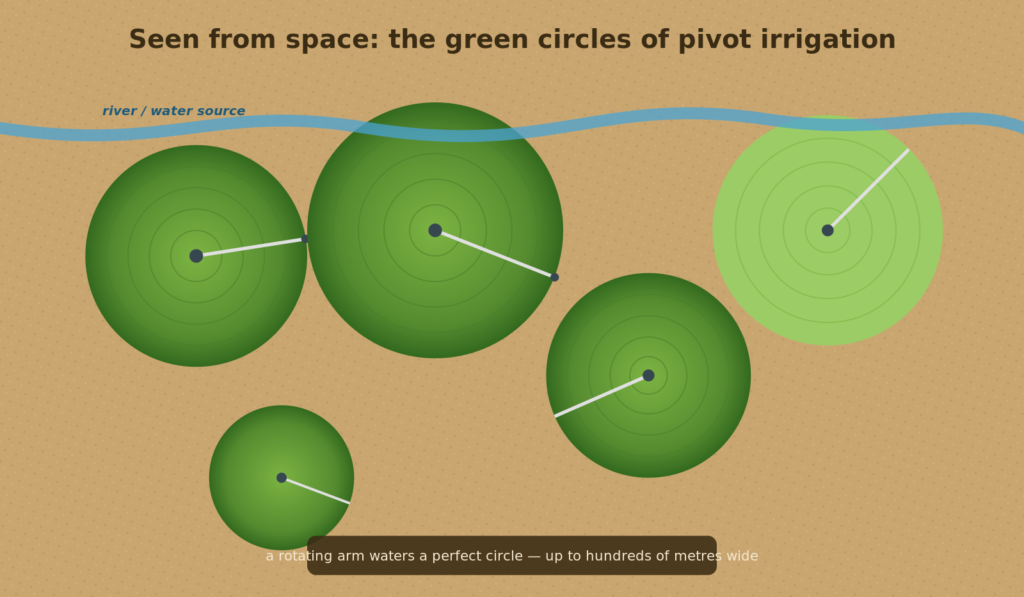
From above, the method reveals itself: each circle is one rotating arm at work.
How pivot irrigation works
The system is clever in its simplicity. A central tower stands in the middle of the field, fed by a pump and a water source. From that tower, a long steel arm reaches out, held up by wheeled legs. As the arm slowly turns, sprinklers along it spray a fine, even rain. Therefore, the whole circle gets the same amount of water. Smart controls let a farmer tune the dose by soil, crop and weather. More and more, the pump runs on solar power instead of diesel.
The advantages
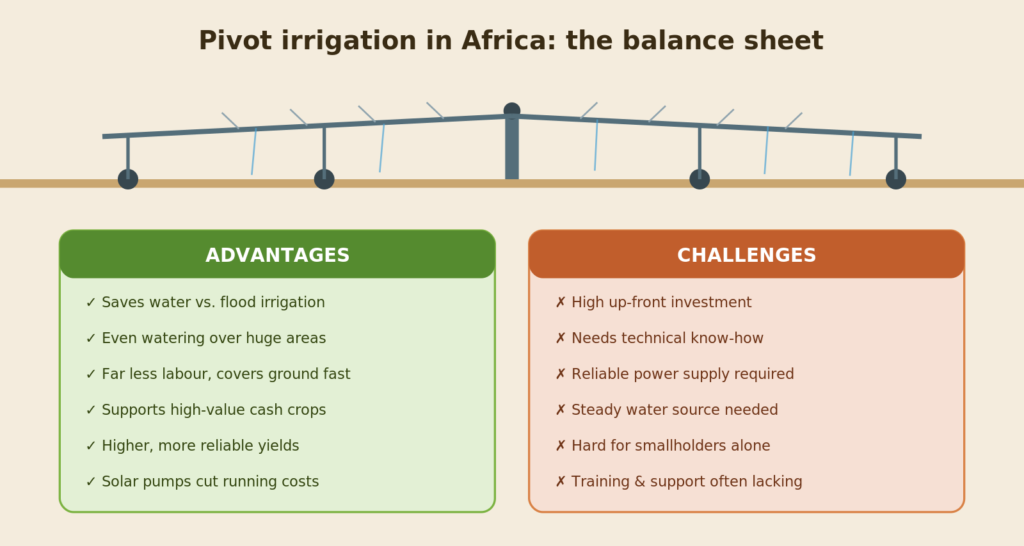
Saving water is the headline benefit. Next to old flood methods, a pivot uses far less water, because it drops it straight onto the crop. That matters greatly in the dry and half-dry climates common across Africa. Furthermore, one system covers a huge area with very little labour. As a result, farmers save both time and money.
The gains do not stop there. Even watering suits high-value crops, from vegetables to seed maize, which lifts both yield and income. Moreover, solar pumps now cut the running costs that once made watering so dear. In short, the method turns dry, idle land into rich fields.
The challenges
However, the pivot is not a magic fix. The biggest barrier is money: a full system costs a lot to set up. In addition, it needs technical skill that many small farmers do not yet have. Basic services are a further hurdle. Without steady power and a sure water source, even the best system struggles. So training and support are vital. Only then can farmers clear these hurdles and reap the full rewards.
What is happening on the ground
The picture is changing quickly, and solar power is the driver. For example, the Kenyan company SunCulture had installed pay-as-you-go solar pumps on more than 40,000 farms across Kenya, Uganda and Ethiopia by 2024. Meanwhile, Rwanda aims to nearly double its solar-irrigated area by 2029. The market reflects this momentum: analysts expect the Middle East and Africa center-pivot market to grow strongly through the next decade. Pay-as-you-go finance is the key that unlocks the door, because it turns a large up-front cost into small, affordable payments.
Part of a bigger water story
Pivot irrigation is one tool among many. In the driest places, low-tech answers still shine — think of contour trenching to catch the rain, the Waterboxx to grow trees with dew, or the Water Pyramid to make drinking water from sunlight. Each fits a different scale and setting. Together, they form one holistic approach to water and food — and pivot irrigation is the option for large, commercial fields.
Conclusion
In conclusion, the pivot offers a real path to higher farm output in Africa. By lowering the cost barrier and sharing know-how, the continent can spread its gains further. Solar power and smart finance now make that more realistic than ever. Step by step, these green circles can help Africa move towards food security and lasting growth.
Curious how efficient irrigation could fit your project or region? Feel free to get in touch — this is part of my services.
Related articles on this site
 Contour Trenching: Just Dig, and the Desert Turns Green
The Waterboxx: Growing Trees in the Desert with Dew and Rain
A Holistic View on Agriculture, Communities, Sustainability and Innovation
Sources and further reading
Mongabay — Smallholder agriculture blossoming with renewables in Africa
Market Data Forecast — Middle East & Africa Center Pivot Irrigation Systems Market